
Romeo and Juliet Laws by State: Age of Consent and Close-in-Age Exemptions
Overview
"Romeo and Juliet law" is not a phrase you will find in any statute book. It is shorthand — borrowed from Shakespeare's teenage lovers — for a category of state provisions that treat consensual sexual activity between two people close in age differently from activity between a teenager and a significantly older adult. Depending on the state, these provisions may eliminate criminal liability entirely, reduce a felony to a misdemeanor, or simply remove the requirement that a convicted person register as a sex offender.
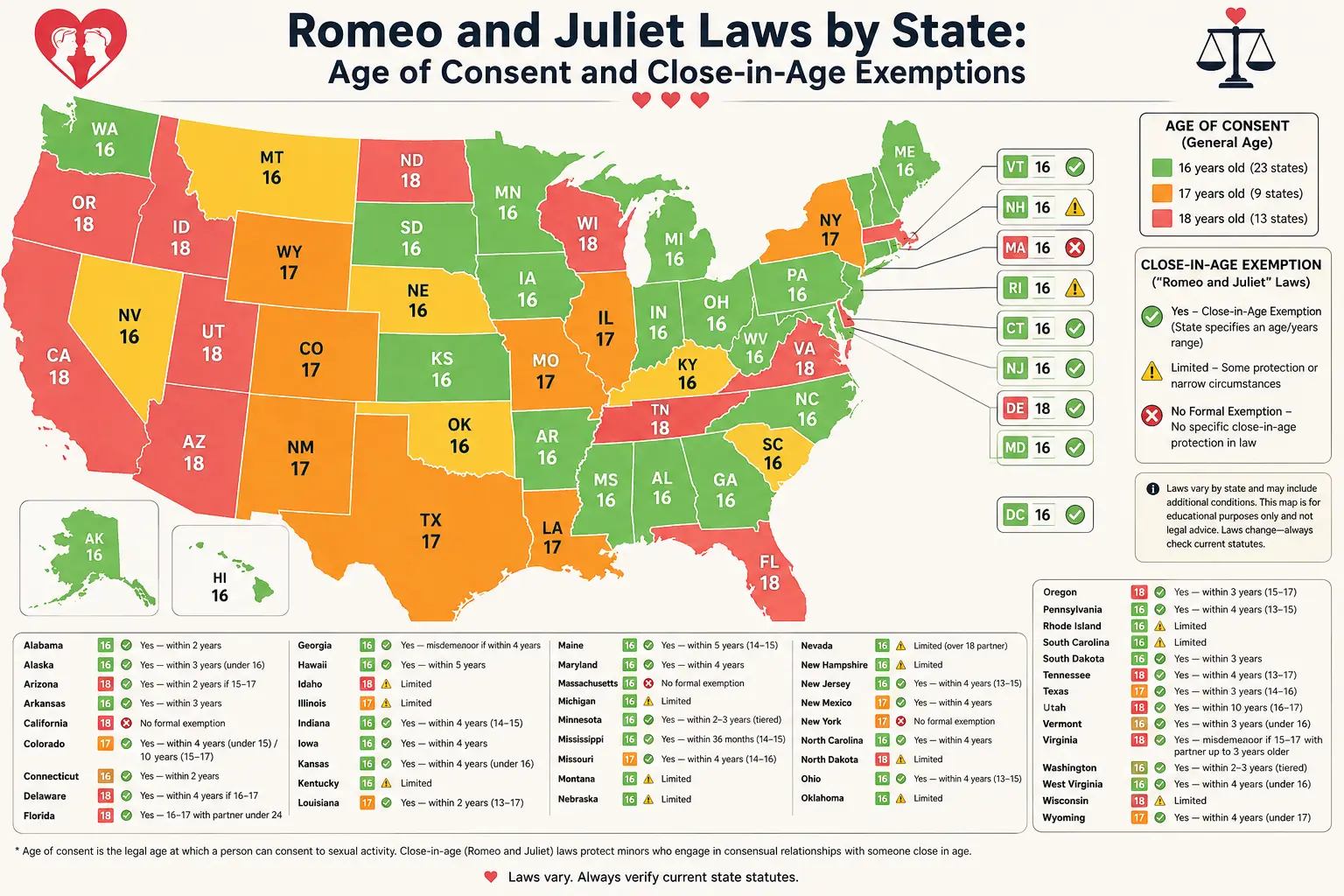
The United States has no single age of consent. Because criminal law in this area is almost entirely a matter of state authority, the age at which a person is legally capable of consenting to sexual activity ranges from 16 to 18 depending on where they stand. Roughly thirty states set the line at 16, a smaller group at 17, and the remainder at 18. Two teenagers whose relationship is entirely lawful in one state may cross a state line and find that the same conduct is a felony.
Close-in-age provisions exist because legislatures recognized a mismatch between the purpose of statutory rape law and its literal application. Age of consent statutes were written to protect minors from exploitation by adults who hold power, experience, or authority over them. Applied without exception, those same statutes sweep in a seventeen-year-old and a fifteen-year-old dating in the same high school. Most legislatures concluded that outcome was neither intended nor just, and carved out a narrow zone of tolerance. How narrow that zone is — and what exactly it protects against — varies enormously.
The table below summarizes where each state currently stands. Read it as an orientation tool, not a legal conclusion. The section that follows explains what the columns can and cannot tell you.
Romeo and Juliet Laws by State: Comparison Table
Each U.S. state defines its own age of consent and close-in-age exemptions. Select a state below for an in-depth overview of statutes, penalties, and frequently asked questions.
| State | Age of Consent | Close-in-Age Exemption | |
|---|---|---|---|
| Alabama | 16 | Yes — within 2 years | View |
| Alaska | 16 | Yes — a 3-year age difference is required for liability where the minor is 13–15 | View |
| Arizona | 18 | Yes — within 2 years if 15-17 | View |
| Arkansas | 16 | Limited — 3-year defense only under 14 | View |
| California | 18 | No formal exemption | View |
| Colorado | 17 | Yes — within 4 years (under 15) / 10 years (15-16) | View |
| Connecticut | 16 | Yes — 13–15 with actor less than 3 years older | View |
| Delaware | 18 | 4-year defense applies to ages 12–15, not 16–17 | View |
| Florida | 18 | Yes — 16-17 with partner under 24 | View |
| Georgia | 16 | Yes — misdemeanor if within 4 years | View |
| Hawaii | 16 | Yes — 14–15 with actor less than 5 years older | View |
| Idaho | 18 | Yes — 16–17 with actor less than 3 years older | View |
| Illinois | 17 | Yes — 13–16 with actor less than 5 years older (misdemeanor) | View |
| Indiana | 16 | Yes — gap of 4 years or less, plus an ongoing relationship requirement | View |
| Iowa | 16 | Yes — 4-year gap, but only one of four triggering circumstances | View |
| Kansas | 16 | Yes — victim 14–15, offender under 19, gap under 4 years | View |
| Kentucky | 16 | Limited — offender-age floors, not a gap rule | View |
| Louisiana | 17 | Yes — graduated: ≤2 years no offense, >2–<4 misdemeanor, ≥4 felony | View |
| Maine | 16 | Yes — 14–15, actor must be 18+ AND 5+ years older to offend | View |
| Maryland | 16 | Yes — 14–15 under 4 years; 4+ years is a misdemeanor until the actor turns 21 | View |
| Massachusetts | 16 | No formal exemption | View |
| Michigan | 16 | Registry relief only — victim 13–15, offender not more than 4 years older | View |
| Minnesota | 16 | Yes — tiered in months: 36 (under 14), 24 (14–15), 48 (16–17 with authority) | View |
| Mississippi | 16 | Yes — 14–15: actor 18+ and 36+ months older; under 14: actor 17+ and 24+ months | View |
| Missouri | 17 | Two frameworks — statutory rape needs an actor 21+; molestation uses a 4-year gap | View |
| Montana | 16 | Gaps sit in the penalties (3 yrs contact / 4 yrs penetration), plus a mistake-of-age defense | View |
| Nebraska | 16 | Actor-age floor of 19, not a gap rule | View |
| Nevada | 16 | Not a gap rule — two floors keyed to the actor's own age, 18 and 21 | View |
| New Hampshire | 16 | 5 years for contact with a 13–15-year-old; no gap at all for penetration | View |
| New Jersey | 16 | Yes — 13–15 with actor less than 4 years older; 16–17 governed by relationship | View |
| New Mexico | 17 | Two stacked requirements — actor 18+ AND at least 4 years older | View |
| New York | 17 | No formal exemption | View |
| North Carolina | 16 | Yes — within 4 years | View |
| North Dakota | 18 | Not a gap rule — a misdemeanor tier where the adult is under 22 and the minor is 15–17 | View |
| Ohio | 16 | Yes — within 4 years (13-15) | View |
| Oklahoma | 16 | Limited | View |
| Oregon | 18 | Yes — an affirmative defense where the actor is less than 3 years older | View |
| Pennsylvania | 16 | Yes — under 16 with actor less than 4 years older; graded at 4 and 11 years | View |
| Rhode Island | 16 | Actor-age floor of over 18, not a gap rule | View |
| South Carolina | 16 | None — graded by the victim's age band, not by an age gap | View |
| South Dakota | 16 | Yes — 13–15 with perpetrator less than 3 years older | View |
| Tennessee | 18 | Yes — 13–17 with defendant less than 4 years older; then graded at 5 and 10 years | View |
| Texas | 17 | Yes — 3-year affirmative defense, victim 14+, actor not already a registrant | View |
| Utah | 18 | 16–17: 7 to under 10 years with knowledge of age; 10+ years under a separate branch | View |
| Vermont | 16 | Not a gap rule — actor under 19, child at least 15, conduct consensual | View |
| Virginia | 18 | Misdemeanor for ages 15–17 regardless of gap; 3-year rule applies only between minors at 13–14 | View |
| Washington | 16 | Yes — within 2-3 years (tiered) | View |
| West Virginia | 16 | Under 4 years (under 16), actor 16+ — but § 61-8D-5 overrides it in most real cases | View |
| Wisconsin | 18 | None — no close-in-age exemption of any kind | View |
| Wyoming | 17 | 13–15: actor must be 17+ AND 4+ years older; 16–17 needs a position of authority | View |
How to Read This Table
"Age of consent" is a floor, not a full picture
The age of consent is the age at which a person is legally capable of agreeing to sexual activity with an adult. Below that age, the law treats agreement as legally meaningless — a minor's willingness, enthusiasm, or initiation does not create a defense. But the single number in the second column conceals a tiered structure in most states. Many jurisdictions grade offenses by the victim's age band: conduct involving a child under 12 or 13 is punished far more severely than conduct involving a 15-year-old, even though both fall below the age of consent. A state listed at "16" may have three or four separate offenses stacked underneath that figure.
"Limited" means the protection is conditional
Where the third column reads Limited, the state offers something less than a clean exemption. That may mean the provision applies only to certain kinds of conduct, only to a narrow age band, only as a sentencing factor, or only to relieve the defendant of sex offender registration while leaving the conviction intact. It may also mean the state reduces the charge from a felony to a misdemeanor rather than eliminating it. In practical terms, "Limited" is a signal to read the state page carefully rather than assume safety.
"No formal exemption" does not always mean maximum exposure
A handful of states — California, New York, and Massachusetts among them — have no standalone close-in-age statute. That does not necessarily mean a nineteen-year-old and a seventeen-year-old face identical exposure to a forty-year-old and a seventeen-year-old. Several of these states achieve a similar effect through offense grading: the age gap determines which degree of offense is charged and whether it is a felony or misdemeanor. The mechanism differs; the practical softening may still exist. Again, the state page is where that detail lives.
Exemption Versus Affirmative Defense
One of the most consequential distinctions in this area is procedural, and it rarely appears in summary tables.
In some states, the close-in-age element is written into the offense itself. If the age gap falls within the permitted range, the prosecution simply cannot prove a necessary element, and no crime occurred. The burden sits with the state from the beginning.
In other states, the provision operates as an affirmative defense. The conduct is criminal on its face, and the defendant carries the burden of raising and proving the age relationship — usually by a preponderance of the evidence. This has real consequences. An affirmative defense does not prevent arrest. It does not prevent charges from being filed. It does not prevent the case from reaching a courtroom. It is something a defense attorney argues after the machinery has already started moving, and it requires evidence — birth records, testimony, documentation of the timeline.
Two states may look identical in a comparison chart and produce entirely different experiences for a teenager and their family, depending on which of these structures the legislature chose.
Factors That Override or Defeat a Close-in-Age Defense
Even where a close-in-age provision clearly applies on paper, several circumstances commonly remove its protection.
Positions of trust or authority. Nearly every state disqualifies defendants who hold authority over the younger person — teachers, coaches, clergy, employers, guardians, foster parents, tutors, counselors, and sometimes anyone in a supervisory role. These statutes typically apply up to age 18 regardless of the age of consent and regardless of how small the age gap is. A twenty-year-old assistant coach and an eighteen-year-old athlete may still fall within a prohibited relationship.
The nature of the conduct. Some exemptions cover only sexual intercourse and not other sexual acts, or apply to one statutory offense while leaving a parallel offense fully chargeable.
Force, incapacity, or lack of actual consent. Close-in-age provisions address the age barrier to consent only. They are irrelevant where force, threat, intoxication, unconsciousness, or intellectual disability is alleged. Those cases proceed as sexual assault prosecutions independent of anyone's birthday.
Explicit images. This is the most common and most damaging blind spot. Child sexual abuse material laws operate separately from age of consent law, and in most jurisdictions they contain no close-in-age exemption whatsoever. Two teenagers whose physical relationship is lawful can commit serious felonies by photographing it or exchanging images by phone. A minority of states have added graduated or diversionary provisions for peer-to-peer sexting; most have not. See our sexting laws by state guide.
Crossing state lines. Age of consent follows the location of the conduct, not the residence of the parties. Traveling to another state for the purpose of sexual activity with a minor can also trigger federal jurisdiction, which brings its own rules and no state-law exemptions.
Federal law. Federal statutes apply on federal property, tribal land, military installations, and in certain interstate contexts. Federal law includes its own four-year age-gap provision for a specific age band, but its structure does not track any particular state's approach.
Sex Offender Registration
For many families, registration is the outcome that matters most. A conviction can be a misdemeanor with no jail time and still carry a registration obligation lasting years or a lifetime — with residency restrictions, employment barriers, school and campus limitations, and public listing.
States handle this inconsistently. Some close-in-age provisions eliminate registration automatically. Some leave it to judicial discretion. Some require registration but allow a later petition for removal after a waiting period. And some offer no relief at all. Because registration consequences frequently outlast the sentence itself, any plea discussion should address them explicitly and in writing. Read more in our sex offender registry laws guide.
Common Misconceptions
"They said they were eighteen." Most states treat statutory offenses as strict liability regarding age. A reasonable, good-faith mistake — even one supported by a fake ID — is not a defense in the majority of jurisdictions. A minority permit it in narrow circumstances.
"Their parents approved." Parental consent has no bearing on criminal liability. Parents cannot authorize conduct the legislature has criminalized.
"They agreed, so it wasn't a crime." Agreement is precisely what the law declines to recognize below the age of consent. That is the entire premise of the offense.
"Being the same grade in school makes it legal." Grade level is legally irrelevant. Only the birth dates matter, and a same-grade pair can easily be separated by more than a year.
"It's a two-year rule everywhere." Age gaps in the table above range from two years to ten, with different rules for different age bands within a single state.
Frequently Asked Questions
Do Romeo and Juliet laws apply to same-sex relationships? Modern statutes are written in gender-neutral terms and apply equally. Older provisions that distinguished by sex have been struck down or repealed following constitutional challenges.
Which state's law applies if we live in different states? Generally the law of the state where the conduct occurred. Interstate travel can add federal exposure.
Can charges be filed if no one complains? Yes. Prosecutors, not families, decide whether to bring charges. Cases frequently begin with a mandatory report from a school, clinic, or hospital rather than a complaint from either party.
Does marriage change the analysis? Some states include a spousal exception. Because states have raised minimum marriage ages substantially in recent years, this exception has narrowed considerably.
Do these laws affect civil or family court matters? They can. Custody proceedings, protective orders, school discipline, and child welfare investigations follow their own standards and may proceed regardless of the criminal outcome.
If You Are Facing a Charge or Investigation
Speak to a criminal defense attorney licensed in the state where the conduct occurred before speaking to anyone else, including investigators who present the conversation as informal. Do not attempt to explain the age difference to police on the theory that it clears things up — that is an argument for counsel to make, with evidence, at the right procedural moment. Preserve documentation of dates and ages, and avoid deleting messages, which can create separate charges. Ask any attorney you consult specifically about registration consequences, not just the sentence. Our find a lawyer directory and legal aid resources can help you start.
Legal Disclaimer
The information on this page is provided for general educational purposes only and does not constitute legal advice, create an attorney–client relationship, or substitute for consultation with a licensed attorney. State statutes change frequently, and the application of any law depends entirely on the specific facts of your situation. The summaries above are simplified for comparison and omit exceptions, tiered offense structures, and procedural details that may be decisive in an individual case. If you are facing a legal issue, contact a licensed attorney in your jurisdiction.