
Editorial note: This article is written for informational purposes and should be verified with official sources where applicable.
Legal disclaimer: This content provides general legal information, not legal advice. Close-in-age laws vary widely by state and may change. Anyone facing an investigation, school complaint, arrest, or criminal charge should speak with a licensed attorney in the relevant state.
Direct Answer
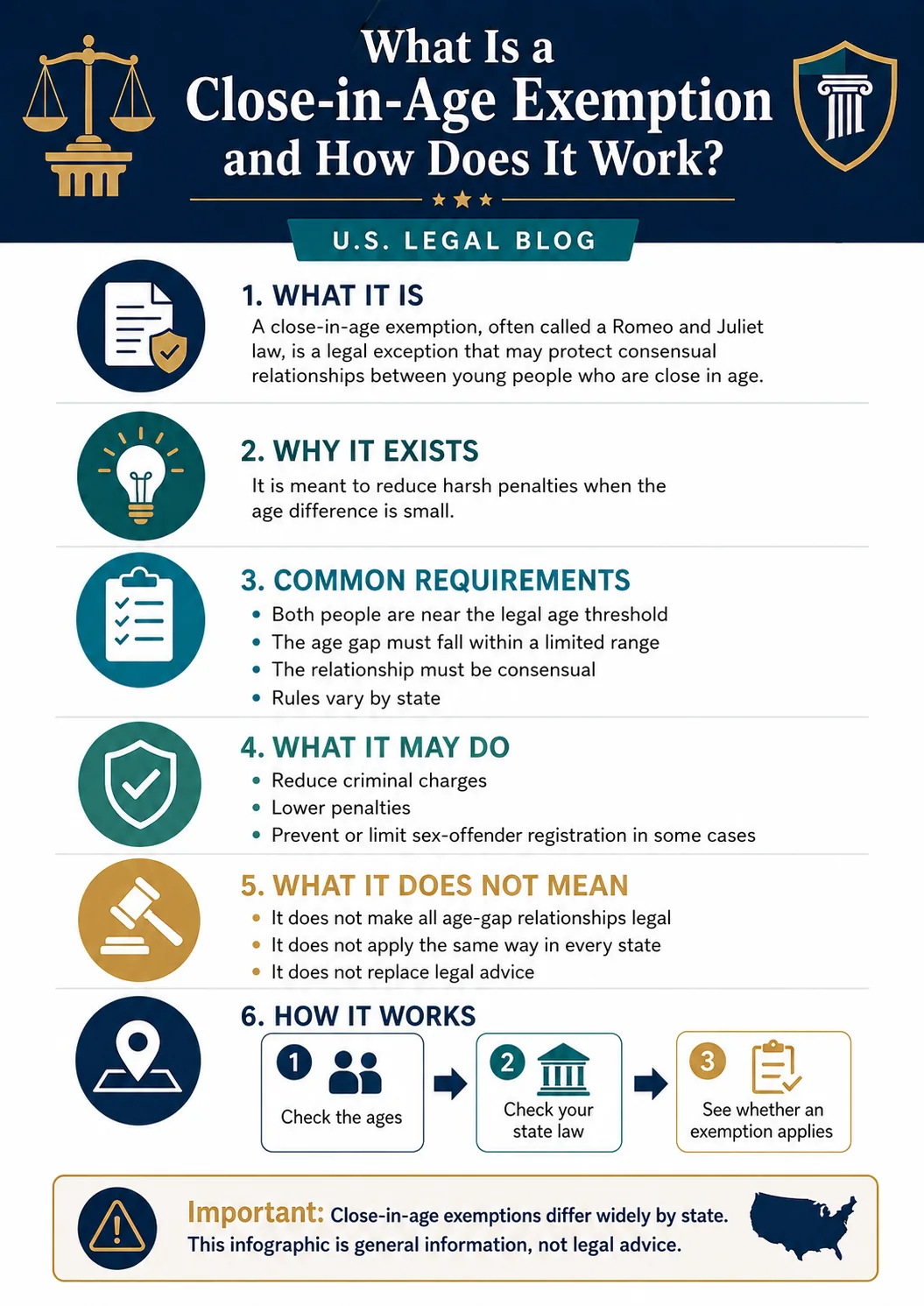
A close-in-age exemption is a legal rule that may protect teenagers or young adults from certain criminal charges when they engage in consensual sexual activity with someone close to their own age.
It is often called a "Romeo and Juliet law." However, there is no single nationwide Romeo and Juliet law. Each state creates its own age limits, age-gap rules, defenses, exceptions, and restrictions.
Some states allow a complete defense. Others reduce the offense or penalty. A few provide only limited relief from sex offender registration. The exemption usually doesn't apply if there was force, coercion, exploitation, an authority relationship, or sexually explicit images involving a person under 18.
Introduction
Age-of-consent laws are designed to protect minors from sexual exploitation. However, lawmakers also recognize that a relationship between two teenagers may be different from a relationship between a young teenager and a much older adult.
A close-in-age rule attempts to address that difference.
For example, a state may treat a consensual relationship between a 16-year-old and an 18-year-old differently from conduct involving a 16-year-old and a 30-year-old. That doesn't mean every relationship between teenagers is automatically legal. It means the participants' ages may affect how the law applies.
The age of consent is not the same across the United States. It generally ranges from 16 to 18, depending on the state and the type of conduct involved. Some states also impose special rules involving teachers, coaches, foster parents, counselors, guardians, healthcare workers, and other authority figures.
Students and parents should avoid relying on social media posts or statements such as, "A three-year age difference is always legal." The real answer depends on the state statute, exact birth dates, type of conduct, relationship between the people, and whether any images were created or shared.

How a Close-in-Age Exemption Works
A close-in-age exemption normally applies through several legal requirements. Every listed requirement may need to be satisfied.
The younger person must meet a minimum age
A close-in-age law may establish a minimum protected age.
For example, a law might apply only when the younger person is at least 14. If the younger person is below that limit, the exemption may not apply regardless of the age difference.
This is one reason the phrase "within three years" can be misleading. An age gap alone doesn't determine the answer.
The participants must be within the permitted age gap
The law may permit an age difference of two, three, four, or another specified number of years.
The exact calculation matters. Courts and attorneys may examine:
- Each person's full date of birth
- The date of the alleged conduct
- Whether the older person had recently crossed an age threshold
- The younger person's age on that specific date
A 17-year-old and a 20-year-old may appear to be three years apart. Their exact birth dates could place them more than three years apart under a statute.

The conduct must fall within the covered category
A detail that's easy to miss is that one state may have several different sexual-offense statutes.
A close-in-age defense may apply to one offense but not another. The law may distinguish between:
- Sexual intercourse
- Sexual contact
- Online solicitation
- Indecent exposure
- Providing sexual material to a minor
- Recording sexual conduct
- Possessing or distributing explicit images
- Conduct involving payment or something of value
Never assume that an exemption applying to physical conduct also applies to messages, photographs, or videos.
The activity must be genuinely consensual
Close-in-age laws generally don't protect conduct involving force, threats, pressure, manipulation, or an inability to consent.
Consent requires more than the absence of physical resistance. A person may be unable to consent because of unconsciousness, severe intoxication, disability, fear, coercion, or another legally recognized condition.
Consent must also continue throughout the interaction. Agreeing to one act doesn't automatically mean agreeing to every act.
The older person may not hold a position of authority
Many states impose separate restrictions when one person has power over the other.
Examples may include:
- Teachers and students
- Coaches and athletes
- School employees and enrolled students
- Foster parents and foster children
- Guardians and dependents
- Counselors and clients
- Clergy members and people receiving counseling
- Healthcare providers and patients
- Juvenile detention employees and residents
An age difference that might qualify in an ordinary relationship may not qualify when an authority relationship exists.
Texas, for example, has separate rules covering improper relationships between educators and students. Its close-in-age provisions for those relationships contain additional conditions rather than creating automatic permission based only on age.
Prior offenses may affect eligibility
Some state defenses exclude people with certain prior convictions or registration obligations.
This means two people with identical age differences could receive different legal treatment based on the older person's criminal history.
The statute must be reviewed as a whole. Reading only the sentence containing the age-gap limit can produce the wrong answer.
Close-in-Age Exemption vs. Age of Consent
The age of consent and a close-in-age exemption are related, but they aren't the same.
The age of consent is the age at which a person can generally consent to covered sexual activity under state law.
A close-in-age exemption may apply when one or both participants are below the ordinary age threshold but are sufficiently close in age.
How the concepts compare
- Age of consent — establishes when a person may generally consent under state law; makes certain age-based restrictions inapplicable after the threshold.
- Statutory exception — excludes qualifying conduct from an offense; may prevent the conduct from meeting the crime's definition.
- Affirmative defense — gives an accused person a legal defense after charges are filed; may defeat liability if the required facts are proven.
- Reduced offense or penalty — treats close-in-age conduct less severely; may lower the charge, sentence, or classification.
- Registration relief — addresses sex offender registration consequences; may allow removal or avoidance of registration under limited conditions.
The wording matters. An "exception" and an "affirmative defense" may produce different legal procedures.
With a statutory exception, the prosecution may need to prove that the exception doesn't apply. With an affirmative defense, the defendant may need to raise and establish the defense under the state's procedural rules.
A registration-relief provision may be even narrower. It might not erase the conviction or declare the conduct lawful. It may only allow a court to remove a registration requirement.
Why These Laws Differ Between States
Sexual-offense laws are primarily created by individual states. Each legislature decides how to define minors, consent, covered conduct, age gaps, authority relationships, penalties, and defenses.
As a result, neighboring states may treat similar conduct differently.
A relationship that qualifies for protection in one state may fall outside the exemption in another. The applicable law may become more complicated if the individuals live in different states, travel across state lines, or communicate online.
The location of the conduct can matter. So can the location where messages or images were sent, received, stored, or distributed.
Students shouldn't assume that the law from their home state follows them everywhere. See our age of consent laws in your state for a full breakdown.

Different Ways States Handle Close-in-Age Cases
Many people assume every state has one clear Romeo and Juliet provision. That's not always true.
States may handle close-in-age situations through several approaches.
Conduct may be excluded from the offense
A statute may define the offense so that it applies only when the older person exceeds a particular age or age difference.
In Florida, for example, the statute addressing unlawful sexual activity with certain minors applies to a person aged 24 or older who engages in the defined activity with a person aged 16 or 17. This specific provision therefore treats a person aged 23 differently from someone aged 24 or older. Other laws and circumstances may still apply.
The accused person may receive an affirmative defense
An affirmative defense doesn't necessarily stop an arrest or accusation. Instead, it provides a legal basis for defending against prosecution.
Texas Penal Code Section 22.011 includes a close-in-age defense containing several conditions. One condition is that the actor must not be more than three years older than the victim. The provision also includes requirements concerning the younger person's age and the actor's registration or conviction history.
The offense or sentence may be reduced
Some states don't fully legalize the conduct. They classify it as a less serious offense when the participants are close in age.
This distinction matters. A reduced charge can still create:
- A criminal record
- Probation requirements
- School discipline
- Employment consequences
- Immigration concerns
- Restrictions involving children
- Registration issues
A person shouldn't interpret "less serious" as "legal." Our guide on statutory rape charges and defenses explains this in more depth.
A court may grant registration relief
Florida provides a separate process through which certain qualifying people may request removal of a sex offender or sexual predator registration requirement.
Among other requirements, the person must be no more than four years older than a victim who was at least 13 but younger than 18. The court must review the motion, and relief is not automatic. Removal from the public registry also doesn't erase otherwise available criminal history records.
This is a good example of why the phrase "Florida's Romeo and Juliet law" can cause confusion. One provision addresses the underlying offense, while another addresses possible registration relief.
What Close-in-Age Laws Usually Don't Protect
A close-in-age provision normally has clear boundaries.
Force, threats, or coercion
No age-gap rule gives someone permission to force, threaten, pressure, or manipulate another person.
The defense may fail if the younger person:
- Said no
- Withdrew consent
- Was threatened
- Was physically restrained
- Feared retaliation
- Was pressured through blackmail
- Couldn't understand what was happening
- Was unconscious or seriously impaired
Exploitation by an authority figure
Teachers, coaches, employers, foster parents, guardians, and counselors may face special restrictions.
A student being above the ordinary age of consent doesn't always make a teacher-student relationship lawful.
Commercial sexual activity
Close-in-age rules should never be assumed to cover conduct involving money, gifts, housing, drugs, transportation, or another benefit exchanged for sexual activity.
Federal law defines child sex trafficking broadly when a minor is caused to engage in a commercial sex act. The "thing of value" involved doesn't have to be cash.
Explicit photographs and videos
This is one of the most serious misunderstandings among teenagers.
A state close-in-age rule for consensual physical activity does not automatically permit the production, possession, or sharing of sexually explicit images.
Federal law generally defines a minor as someone under 18 for child sexual abuse material laws. The Department of Justice states that a state's age of consent is irrelevant to whether an explicit depiction of someone under 18 is prohibited under federal law.
That means a relationship may qualify for a state close-in-age defense while explicit images from the same relationship create separate legal risks.
Students should not request, create, save, forward, repost, or threaten to distribute an explicit image of anyone under 18. Read more about the legal risks of teenage sexting.
Sharing an image without permission
Nonconsensual distribution may violate additional criminal or civil laws, even when everyone shown is an adult.
Threatening to share an image can also become evidence of coercion, harassment, stalking, extortion, or another offense.
Does Parental Permission Make the Relationship Legal?
Usually, parental approval doesn't replace the requirements of criminal law.
Parents may approve of a dating relationship. That approval doesn't change the participants' ages, the statutory age gap, or restrictions involving sexual conduct.
A parent also can't generally authorize conduct that a criminal statute prohibits.
Marriage may affect certain laws in some states, but it should never be treated as a universal exception. Marriage-age requirements and sexual-offense exceptions are separate legal questions.
Does Not Knowing the Person's Age Provide a Defense?
Sometimes people assume they're protected because the younger person lied about their age or appeared older.
That assumption can be dangerous.
Some statutes limit or reject mistake-of-age defenses. Texas's sexual-assault statute, for example, describes certain conduct involving a child as an offense regardless of whether the actor knew the child's age.
The rule varies by jurisdiction and charge. A fake profile, altered identification card, or false statement about age may be relevant evidence, but it doesn't automatically prevent prosecution.
The safest approach is not to guess. Verify age before beginning any sexual relationship, especially through an online platform.
Practical Examples
The following examples are educational hypotheticals. They don't predict how a real case would be resolved.
Example 1: A 16-year-old and an 18-year-old
A 16-year-old and an 18-year-old are in a voluntary dating relationship.
A close-in-age provision might protect this conduct because the age difference is small. However, the answer depends on:
- The state's age of consent
- The minimum age for the exemption
- The exact age difference
- The type of conduct
- The presence of genuine consent
- Whether either person holds authority over the other
The relationship isn't automatically lawful in every state.
Example 2: A 14-year-old and a 19-year-old
The participants are five years apart.
This situation may exceed the permitted age gap. The younger person may also be below the state's minimum age for close-in-age protection.
Calling the relationship consensual may not provide a legal defense because a person below the statutory threshold may lack legal capacity to consent to that conduct.
Example 3: A 17-year-old student and a 20-year-old school employee
The age difference is three years. However, the older person works at the student's school.
A close-in-age defense that might apply in an ordinary dating relationship could be restricted by educator-student laws.
The authority relationship must be reviewed separately from the age gap.
Example 4: A 16-year-old and a 17-year-old exchange explicit photos
The students are only one year apart.
Their physical relationship might fall within a state's close-in-age provision. However, federal and state laws concerning explicit images of minors may still apply.
The small age difference doesn't create a general exemption for producing, possessing, or distributing those images.
Example 5: A person turns 18 during the relationship
Two students begin dating while both are 17. One later turns 18.
Turning 18 doesn't automatically make the relationship criminal. The result depends on the state's exact age-gap and minimum-age rules.
However, the older student should not assume that conduct remains protected. Exact birthdays and the date of each alleged act can matter.
Example 6: Florida residents aged 17 and 23
Florida's Section 794.05 applies when a person aged 24 or older engages in defined sexual activity with a 16- or 17-year-old.
A 23-year-old isn't within that particular age requirement. Still, that fact alone doesn't guarantee that every form of conduct is lawful. Other statutes concerning consent, authority, images, solicitation, or exploitation may apply.
Common Mistakes or Misunderstandings
"Every state allows a four-year age gap"
There is no universal four-year rule.
Some states use a different gap. Some impose several age ranges. Others provide a defense only for specified offenses.
"Romeo and Juliet laws make the relationship legal"
A provision may provide only an affirmative defense, lower charge, or registration remedy.
It may not prevent an investigation or arrest.
"Parental approval is enough"
Parents generally can't override criminal statutes.
Their approval of the relationship doesn't replace the state's legal requirements.
"Consent is the only issue"
Consent matters, but age, capacity, authority, conduct type, and age difference may matter too.
A younger person can willingly participate yet still lack legal capacity under the applicable statute. Learn more about what legally valid consent means.
"Both teenagers will face the same consequences"
The law may treat the older and younger participants differently. Juvenile and adult court procedures can also differ.
School discipline may affect both students even if criminal charges aren't filed.
"Private photos between partners are protected"
The law may treat explicit images separately from physical conduct.
Saving or forwarding an image can create additional exposure. Online platforms may also retain copies after a user believes the image was deleted.
"The older person is safe because the younger person lied"
A false statement about age doesn't always provide a defense.
Some crimes don't require proof that the accused knew the younger person's actual age.
Warnings, Exceptions, and Important Notes
Don't rely on a general online age-of-consent chart
Charts can become outdated. They may also omit:
- Minimum victim ages
- Authority restrictions
- Different types of sexual conduct
- Special rules for school employees
- Age-gap calculations
- Registration requirements
- Mistake-of-age rules
- Image-related offenses
Use the current state code, a state government source, or advice from a licensed attorney.
Don't delete or alter potential evidence after an accusation
Deleting messages, changing accounts, asking someone to change their story, or contacting an accuser can make the situation worse.
A person facing an allegation should stop discussing the facts online and seek legal advice.
Don't speak for a child without understanding the situation
Parents naturally want to protect their child. Still, pressuring a child to deny, minimize, or repeat a particular version of events can interfere with an investigation.
Focus first on safety, emotional support, and qualified legal guidance.
School rules may be stricter than criminal law
A school can investigate conduct under its student code, harassment policy, athletics rules, or Title IX procedures.
The fact that prosecutors don't file charges doesn't necessarily prevent school discipline.
Juvenile records can still have serious consequences
Being handled in juvenile court doesn't mean the matter is harmless.
Possible consequences may include supervision, treatment, school disruption, restrictions on contact, and future background-check issues.
Laws can change
State legislatures amend criminal statutes, registration rules, and procedural requirements.
Always verify the law in effect on the date of the alleged conduct. The current law may differ from the law that governed an older case.

Helpful Next Steps for Students and Parents
If a close-in-age issue has already resulted in an accusation, investigation, or school complaint:
- Prioritize immediate safety. Contact emergency services if anyone is in danger.
- Avoid public discussion. Don't post facts, screenshots, names, or accusations online.
- Preserve relevant information. Keep messages, dates, account records, and other lawful evidence.
- Do not forward explicit images. Sharing them may create further harm and legal exposure.
- Contact a qualified attorney. Find an experienced juvenile defense lawyer with experience in juvenile law, criminal defense, sexual-offense cases, or school disciplinary matters.
- Use reliable support services. A victim or concerned family member may contact RAINN for confidential support and state-specific resources.
- Review the exact statute. Confirm the law that applied in the state and on the date of the alleged conduct.
Key Takeaways and Final Summary
A close-in-age exemption may limit criminal liability when two people close in age engage in consensual sexual activity. It is commonly called a Romeo and Juliet law, but the phrase doesn't describe one uniform federal rule.
The most important points are:
- Every state has its own laws.
- The age of consent generally ranges from 16 to 18.
- The younger person may need to meet a minimum age.
- The age gap must remain within a specific limit.
- Exact birth dates can matter.
- The exemption may apply only to certain offenses.
- Authority relationships may create separate restrictions.
- Force, coercion, incapacity, and exploitation remain unlawful.
- Parental approval doesn't override criminal law.
- A mistake about age may not provide a defense.
- Explicit images involving anyone under 18 create separate and serious risks under federal and state law.
- Some laws provide only a defense, reduced penalty, or registration relief rather than declaring the conduct legal.
Students and parents should verify the current statute in the relevant state. A lawyer must review the actual ages, dates, relationship, communications, type of conduct, and procedural history before giving reliable advice.